
Why Light Is Everything When You Grow Rosemary Indoors in Low Light
Growing rosemary indoors in low light is absolutely possible — but only if you give it the right support.
Here’s the quick answer for anyone short on time:
- Place rosemary in a south-facing window for maximum natural light (aim for 6–8 hours daily)
- Add a full-spectrum LED grow light if your window light falls short — run it for 14–16 hours per day
- Keep the grow light 4–6 inches from the leaves to deliver enough intensity without burning them
- Watch for leggy stems and pale, weak foliage — these are the first signs your plant needs more light
- Reduce watering slightly in low-light conditions, since soil dries more slowly without strong sun Rosemary is a sun-loving herb native to the dry, bright coastlines of the Mediterranean. It evolved under intense sunlight, which is why it struggles in dim indoor rooms. Without enough light, it stops producing the essential oils that give it that bold, piney aroma and flavor you cook with.
The good news? You don’t need a perfect south-facing window to grow it well. With the right artificial lighting setup, rosemary can thrive year-round on your kitchen counter — even in winter.
One thing that surprises most growers: rosemary is sometimes called an “upside-down plant.” It actually prefers to absorb moisture through its foliage from the surrounding air, rather than through wet roots. That means how you manage humidity and watering matters just as much as light — especially indoors.
This guide covers everything you need to set up indoor rosemary lighting correctly, pick the right varieties, and keep your plant healthy through every season.
Understanding Light Requirements to Grow Rosemary Indoors in Low Light
To successfully grow rosemary indoors low light environments, we first have to understand what the plant is “expecting.” In its native Mediterranean habitat, rosemary basks in intense, direct sun for the majority of the day. This light isn’t just for show; it is the fuel for photosynthesis, the process that allows the plant to create energy.
Ideally, rosemary needs 6 to 8 hours of direct sunlight every single day. When we bring it indoors, even a “bright” window often provides significantly less energy than an outdoor garden. Light intensity drops off sharply just a few feet away from a glass pane.
This lack of energy has a direct impact on the chemical makeup of the herb. Sunlight triggers the production of volatile compounds. If you’ve noticed your indoor rosemary smells a bit “dusty” or weak compared to the pungent sprigs from a garden, it’s likely because the plant hasn’t had enough light to produce its signature essential oils. These oils are responsible for the flavor potency in your cooking and the medicinal strength in your teas. For more on the basics of keeping this herb happy, check out our guide on rosemary care indoors for beginners.
Tell-Tale Signs of Light Deprivation
How do you know if your rosemary is “starving” for light? Unlike a human who might get grumpy, a rosemary plant shows its hunger through its physical structure. We call this “etiolation,” but most gardeners simply know it as “leggy growth.”
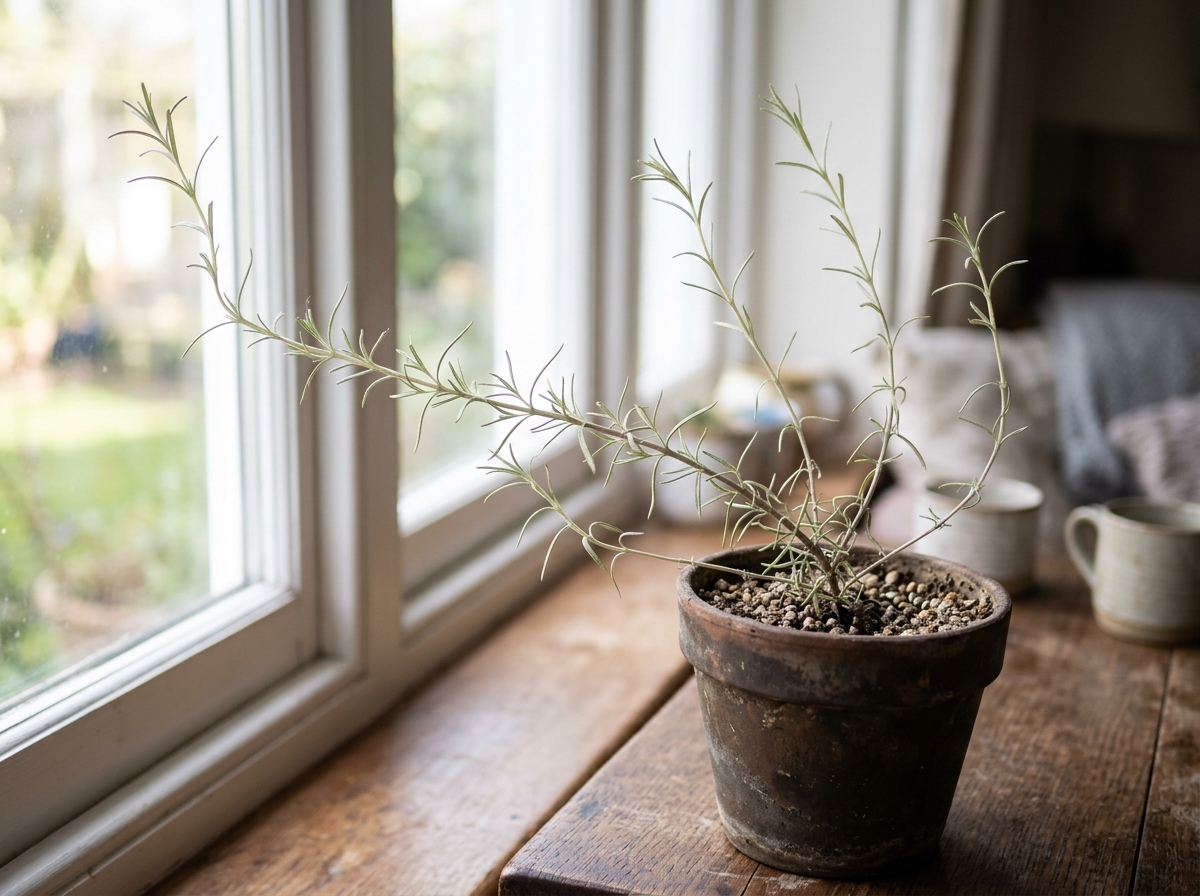
Keep an eye out for these specific symptoms:
- Weak, Floppy Stems: Instead of sturdy, woody branches, the new growth is thin, pale green, and leans heavily toward the nearest light source.
- Sparse Foliage: The distance between the needle-like leaves (the internodes) becomes much wider as the plant tries to “stretch” toward the sun.
- Needle Drop: Rosemary may begin shedding its lower, older needles to conserve energy for the growing tips.
- Reduced Fragrance: If you rub the leaves and don’t get that instant hit of pine and resin, the plant is struggling to maintain its oil production.
Can Rosemary Thrive Without Natural Sun?
The short answer is: yes, but usually not on its own. While a south-facing window is the gold standard for indoor herbs, many of us live in apartments with north-facing views or homes shaded by trees. In these naturally low-light environments, artificial light supplementation isn’t just a “nice to have”—it is an absolute necessity.
Even in a south-facing window, winter months bring shorter days and a lower sun angle, which can cause rosemary to go into a slow decline. We have found that relying solely on natural light in northern climates often leads to a dead plant by February. By integrating artificial lighting, we can bypass seasonal shifts and provide a consistent “Mediterranean summer” all year long. If you’re curious about which other plants play well in these conditions, see our list of the best herbs to grow indoors.
Choosing the Best Artificial Lighting for Rosemary
When you decide to grow rosemary indoors low light conditions, the type of bulb you choose makes all the difference. You can’t just use a standard desk lamp; rosemary needs specific wavelengths of light to thrive.
We highly recommend Full-Spectrum LED grow lights. These are designed to mimic the spectrum of natural daylight, providing the blue light needed for leafy growth and the red light required for stem strength and flowering. Look for lights rated between 3000 and 4000 lumens for sufficient brightness.
| Feature | Full-Spectrum LED | Fluorescent (T5/T8) | Natural Sunlight (South Window) |
|---|---|---|---|
| Intensity | High | Medium | Very High (Variable) |
| Energy Efficiency | Excellent | Good | N/A |
| Heat Output | Low | Low/Medium | High |
| Duration Needed | 14–16 Hours | 16+ Hours | 6–8 Hours |
| Ideal Distance | 4–6 Inches | 2–4 Inches | N/A |
For a deeper dive into the technical side of lighting, our article on grow lights for indoor herbs provides excellent specifications for various setups.
How to Grow Rosemary Indoors with Low Light and LED Supplements
To get the most out of your LEDs, you need to understand PAR (Photosynthetic Active Radiation). This is essentially the “quality” of light that plants actually use for growth. When using LEDs, the goal is to provide high PAR without the intense heat that traditional high-pressure sodium bulbs produce.
Because rosemary is a 3D plant (it grows in all directions), we recommend rotating your pot a quarter-turn every week. This ensures that the “back” of the plant doesn’t become bald or weak. If you are starting from scratch, using a seedling heat mat can help maintain a soil temperature of 70–75°F, which encourages faster root development and helps the plant better utilize the light provided.
Optimizing Light Distance and Duration
One of the most common mistakes we see is hanging the light too far away. Light intensity diminishes exponentially with distance. For rosemary, we want the light fixture to be just 4 to 6 inches above the top of the foliage.
- Duration: Since artificial light is rarely as intense as the actual sun, we need to leave the lights on longer to compensate. Aim for a 14 to 16-hour cycle.
- Rest: Do not leave the lights on 24/7! Like us, plants need a period of darkness (roughly 8 hours) to complete metabolic processes.
- Automation: We strongly suggest using a simple plug-in timer. It ensures your rosemary gets a consistent “day” even if you’re busy or away. You can find more tips on managing these cycles in our guide to grow lights for indoor herbs-2.
Adjusting Care for Low-Light Indoor Environments
When you grow rosemary indoors low light, you must change your watering habits. In a bright, hot outdoor setting, rosemary drinks a lot of water as it evaporates quickly. Indoors, and especially in lower light, evaporation slows down significantly.
The #1 killer of indoor rosemary is overwatering, which leads to root rot. Because the plant isn’t photosynthesizing as rapidly, it doesn’t “pull” water from the soil as fast.
- Soil: Use a well-draining mix. A “cactus or succulent” soil blend is perfect because it contains sand and perlite.
- The Container: Stick with terracotta pots. The porous clay allows the soil to “breathe” and helps excess moisture evaporate through the sides of the pot, protecting the roots.
- The Finger Test: Never water on a schedule. Stick your finger two inches into the soil. If it feels even slightly damp, wait. Only water when the top two inches are bone dry. For more low-maintenance tips, read our article on low-maintenance indoor herb planting.
Managing Humidity and Air Circulation
Rosemary is an “upside-down plant.” It loves dry roots but appreciates ambient moisture in the air—reminiscent of the sea mist in the Mediterranean. However, indoor air in winter is often desert-dry due to heating systems.
To balance this:
- Pebble Trays: Fill a shallow tray with pebbles and water, then set your pot on top (ensure the pot itself isn’t sitting in the water). As the water evaporates, it creates a micro-climate of humidity around the leaves.
- Misting: Gently mist the foliage once or twice a week.
- Airflow: This is crucial. Stagnant, humid air is an invitation for powdery mildew. We recommend using a small oscillating fan nearby to keep the air moving, which also helps strengthen the stems.
Selecting Varieties to Grow Rosemary Indoors in Low Light
Not all rosemary is created equal. Some varieties are naturally more resilient to the “cramped” and dimmer conditions of a house.
- ‘Blue Rain’: A trailing variety that is exceptionally beautiful in hanging baskets or on high shelves. Trailing types often adapt better to the variable light of a room.
- ‘Huntington Carpet’: Another prostrate (trailing) variety that handles indoor life with grace.
- Compact Cultivars: Look for varieties labeled “dwarf” or “compact.” These grow slower and are less likely to become wildly leggy if the light dips slightly.
Choosing the right variety can make your culinary life much easier. Check out our recommendations for the best indoor herbs for cooking to see how rosemary fits into a kitchen garden.
Troubleshooting and Reviving Weak Rosemary Plants
If your rosemary looks like it’s on its last legs, don’t give up! We have seen many “sticks in a pot” return to lush glory with the right intervention.
If the plant is root-bound (roots circling the inside of the pot), it can’t take up nutrients effectively. You might need to perform root pruning. This involves removing the plant, snipping off about one-third of the outer root mass, and repotting it with fresh substrate. Adding a bit of horticultural charcoal to the bottom of the pot can help prevent “sour” soil and root rot, while a mycorrhizal inoculant can give the roots a biological boost to recover faster.
Steps to Acclimate and Recover
To revive a struggling plant, follow this recovery plan:
- The Sunlight “Diet”: If you are moving a plant from a dark corner to a bright grow light, do it gradually. Start with 4 hours of intense light and increase it over a week to avoid “sunburning” the leaves.
- Pruning: Snip off the “leggy” pale tips. This encourages the plant to push out new, bushier growth from the base.
- Feeding: Use a diluted liquid organic fertilizer or a top-dressing of worm castings. Only do this in the spring and summer; rosemary doesn’t want to be fed during its winter “rest” period.
- Fresh Start: Sometimes, the easiest way to recover is to take a cutting from the healthiest branch and start a new, stronger plant. For more beginner-friendly advice on starting fresh, see our guide on easy-herbs-for-beginners-to-grow-indoors.
Frequently Asked Questions about Indoor Rosemary
Can rosemary grow in a room with no windows?
Yes, but only with high-quality artificial lighting. In a windowless room, you must provide 100% of the plant’s energy via a full-spectrum grow light. You will likely need to run the light for 16 hours a day to ensure the plant has enough “food” to survive and grow.
How do I know if my grow light is too close?
Check the tips of the needles. If they are turning brown, crispy, or bleached (white/yellow) while the rest of the plant looks okay, the light is likely too close and causing heat stress or light burn. Simply move the fixture up 2 inches and monitor for improvements.
Why is my indoor rosemary turning brown and crispy?
This is usually a sign of one of two extremes: either the soil has dried out completely for too long (rosemary is drought-tolerant, but it still needs some water), or the roots have rotted from overwatering, preventing the plant from taking up moisture. If the stems are brittle and snap easily, the plant may be beyond saving. If they are still flexible, adjust your watering and check the drainage.
Conclusion
At FinCapitaly, we believe that everyone should have access to fresh, aromatic herbs, regardless of how much natural sunlight their home receives. By mastering the art of artificial lighting and respecting the “upside-down” nature of this Mediterranean classic, you can enjoy year-round harvests of flavorful rosemary.
Remember: start with a well-draining pot, don’t overwater, and when the sun doesn’t shine, let your LEDs do the heavy lifting. With these steps, you’ll create a thriving Mediterranean microclimate right in your own living room.
