
Why Fresh Mint No Longer Needs a Sunny Window
Indoor mint growing without sun is absolutely possible — and easier than most people think.
Here’s the quick answer if you’re in a hurry:
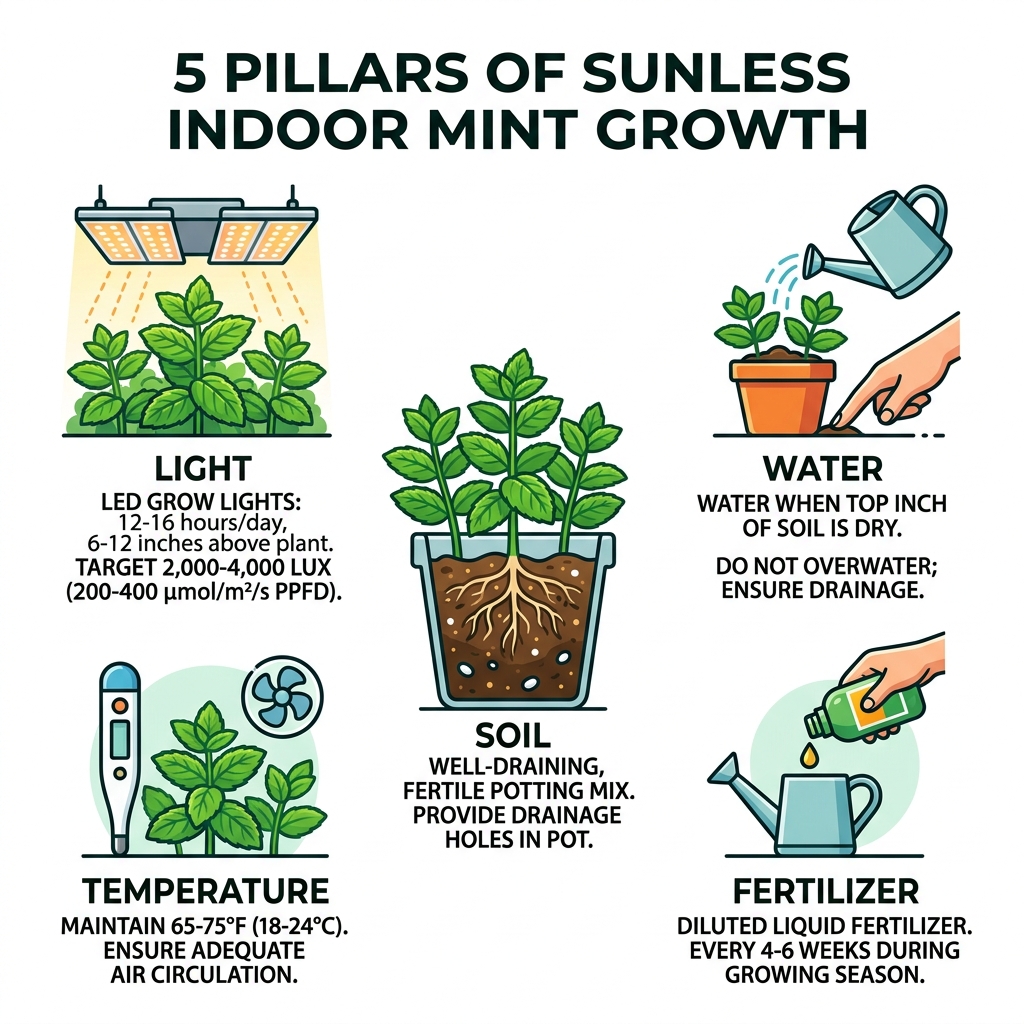
- Use full-spectrum LED grow lights positioned 6-12 inches above your mint
- Run the lights 12-16 hours per day to replace natural sunlight
- Target 2,000-4,000 lux (200-400 µmol/m²/s PPFD) for healthy, bushy growth
- Water when the top inch of soil is dry and keep temperatures between 65-75°F
- Fertilize every 4-6 weeks with a diluted liquid fertilizer
That’s the core of it. The rest is fine-tuning.
Mint is one of the most forgiving herbs you can grow indoors. It tolerates lower light than most herbs, recovers quickly from neglect, and produces fresh leaves year-round — even in a windowless kitchen.
The catch? It still needs some light. Standard room lamps won’t cut it. Without the right spectrum and intensity, mint grows pale, leggy, and weak.
But with a small, affordable grow light and a basic routine, you can harvest fresh mint for teas, cocktails, and cooking every single week — no sunny windowsill required.
The Science of Indoor Mint Growing Without Sun
When we talk about indoor mint growing without sun, we aren’t suggesting the plant lives in total darkness. Instead, we are replacing the sun’s nuclear fusion with high-tech semiconductors. Mint is naturally a “partial shade” plant in the wild, often found spreading under the canopy of taller garden plants. This biological trait makes it the perfect candidate for artificial environments.
To succeed, we need to understand light intensity. In horticulture, we measure this using PPFD (Photosynthetic Photon Flux Density). While a south-facing window might provide 500–1,000 PPFD, mint only needs about 200–400 µmol/m²/s (roughly 2,000–4,000 lux) to stay bushy and aromatic.
Can Mint Grow Indoors Without Sunlight? Yes, With This Method is a question many beginners ask, and the answer lies in the hardware you choose.
Light Technology Comparison Table
| Feature | Full-Spectrum LED | Fluorescent (T5/CFL) | Incandescent |
|---|---|---|---|
| PPFD Range | 200–400+ | 100–250 | Negligible |
| Lifespan | 50,000 hours | 10,000–20,000 hours | 1,000 hours |
| Heat Output | Very Low | Moderate | High (Dangerous) |
| Energy Efficiency | Excellent | Good | Poor |
| Best For | All growth stages | Seedlings/Cuttings | Not recommended |
Best Light Spectrums for Indoor Mint Growing Without Sun
Mint doesn’t just need “white” light; it needs specific wavelengths to perform different biological tasks. The “Photosynthetic Active Radiation” (PAR) range spans from 400 to 700nm.
- Blue Light (400-500nm): This is the “bodybuilder” of the spectrum. It encourages thick stems and dense, leafy vegetative growth. Without enough blue light, your mint will stretch toward the ceiling in a desperate search for energy.
- Red Light (600-700nm): This spectrum helps with flowering and, more importantly for us, the production of essential oils. If you want that sharp, nose-tingling peppermint punch, a bit of red light in the spectrum is vital.
Full-spectrum LEDs are our top recommendation because they provide a balanced “white” light that includes these peaks, mimicking natural daylight without the electricity bill of a small stadium.
Why Standard Household Bulbs Fail
We’ve all tried it: sticking a desk lamp over a plant and hoping for the best. Unfortunately, standard incandescent or decorative LED bulbs usually fail for three reasons:
- Lumen Deficiency: They simply aren’t bright enough. A bulb meant to help you read a book doesn’t have the “punch” to drive photosynthesis 12 inches away.
- Spectral Gaps: Most household bulbs are designed for human comfort (warm yellows or cool whites), skipping the specific blue and red peaks plants crave.
- Heat Damage: Incandescent bulbs produce more heat than light. If you put them close enough to provide energy, they’ll literally cook the mint leaves.
Setting Up Your Sunless Mint Station
Setting up a dedicated herb corner is one of the most rewarding Indoor Tools projects you can undertake. You don’t need a massive greenhouse; a small section of a kitchen counter or a bookshelf will do.
Positioning and Distance
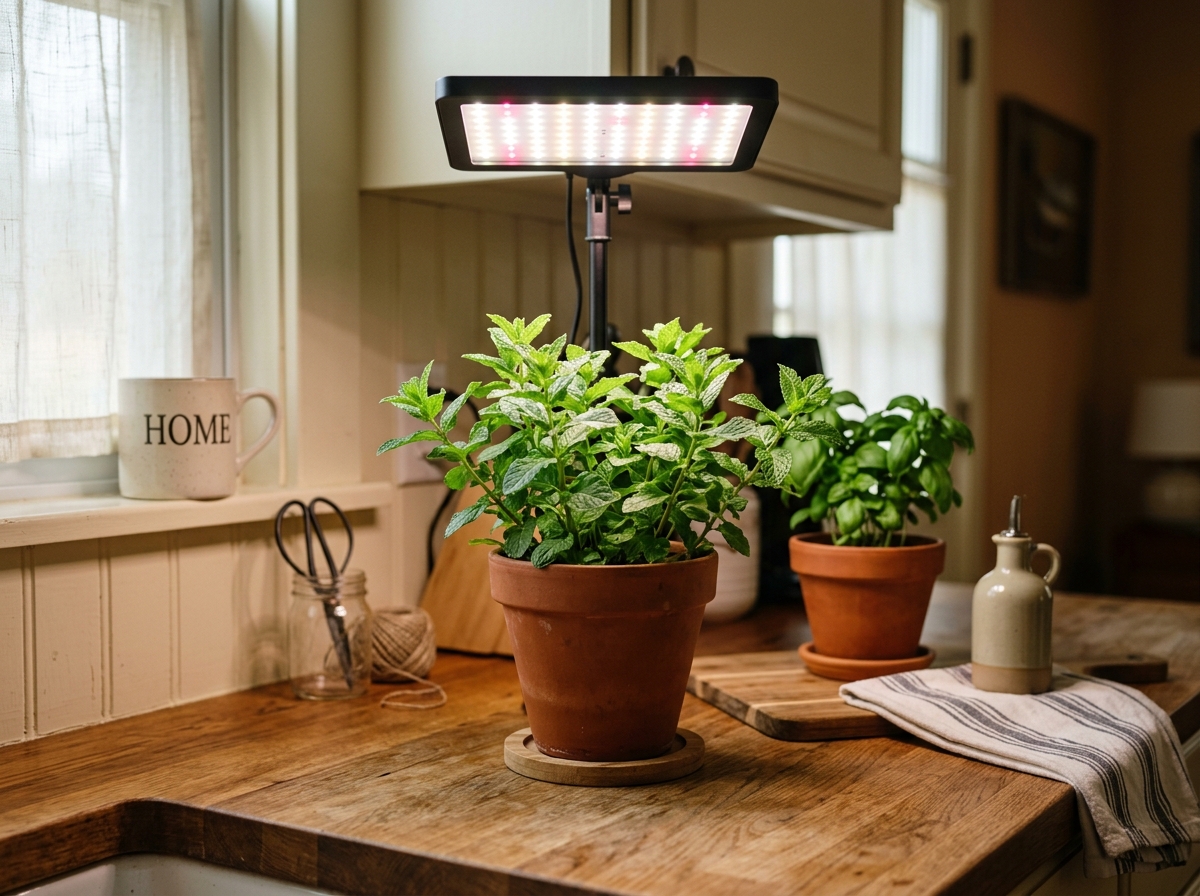
The “sweet spot” for most LED grow lights is between 6 and 12 inches above the top of the plant. If the light is too far away (18-24 inches), the mint will become “leggy”—tall, thin, and weak. If it’s too close, you might see “bleaching” or burnt tips on the leaves.
The 12-16 Hour Rule
Since artificial lights are less intense than the sun, we compensate with duration. We recommend using a simple plug-in timer to run your lights for 14 to 16 hours a day. This mimics a long summer day, keeping the plant in a constant state of vigorous growth.
Air Circulation
In windowless rooms, air can become stagnant, which is an open invitation for powdery mildew. A small USB-powered fan nearby provides the gentle “breeze” necessary to strengthen stems and prevent fungal spores from settling on the damp leaves.
Essential Care and Maintenance Protocols
Growing mint without sun requires a slightly different approach to care than outdoor gardening. Because there is no wind or intense solar heat to dry out the soil, overwatering is the #1 killer of indoor mint.
Follow these Planting Tips for a thriving harvest:
- The Soil Mix: Use a high-quality potting soil amended with 20-30% perlite. Avoid heavy garden soil, which packs down and suffocates roots. Mint loves moisture but hates “wet feet.”
- The Container: Choose a pot at least 8-10 inches wide. Mint spreads via horizontal runners, so a wider pot allows for more “clones” to pop up from the soil, creating a fuller plant. Ensure it has ample drainage holes.
- Temperature: Mint is happiest between 65°F and 75°F. Avoid placing your station directly above a heater vent or next to a drafty AC unit.
- Humidity: Indoor air (especially in winter) is often too dry. Place your pot on a tray filled with pebbles and water. As the water evaporates, it creates a humid micro-climate around the leaves.
For a deeper dive into apartment-specific setups, check out How To Grow Mint Inside All Year in Any Apartment.
Fertilization for Artificial Environments
When indoor mint growing without sun, the plant relies entirely on you for nutrients. However, because growth is slightly slower than outdoors, it’s easy to over-fertilize.
We recommend a liquid organic fertilizer diluted to half-strength. Feed your mint every 4 to 6 weeks during the spring and summer. In the winter, you can scale back to every 8 weeks. Excessive nitrogen can actually dilute the essential oils, leaving you with plenty of leaves that have very little flavor.
Hydroponic Methods for Indoor Mint Growing Without Sun
If you want to skip the soil mess entirely, mint is one of the easiest herbs to grow in water.
- Water Culture: You can grow mint indefinitely in a mason jar of water. Just ensure you add a few drops of liquid hydroponic nutrients every time you change the water (every 5-7 days).
- Oxygenation: For better results, use a small air stone to keep the water oxygenated. This prevents root rot.
- Algae Prevention: Use an opaque jar or wrap your glass jar in paper. Light hitting the water will cause algae to grow, which competes with your mint for nutrients.
Troubleshooting and Propagation Techniques
Even with the best lights, things can go sideways. The most common issue with indoor mint growing without sun is “legginess.” If your mint looks like it’s trying to win a high-jump competition rather than growing into a bush, your light is either too dim or too far away.
Pruning for Success
Don’t be afraid to harvest! In fact, the more you snip, the bushier the plant becomes. Always cut just above a “node” (where leaves emerge from the stem). This signals the plant to send out two new branches from that point.
Propagation: Free Plants Forever
One of the best parts of mint is that it is essentially immortal. You can easily start new plants from your existing one:
- Snip a 3-4 inch cutting.
- Remove the lower leaves.
- Place the stem in a glass of water.
- In 7-14 days, you’ll see white roots.
- Once roots are an inch long, transplant to soil or a hydroponic system.
For more detailed methods, see How to Grow Mint Indoors: 3 Growing Methods for Year-round ….
Troubleshooting Indoor Mint Growing Without Sun
- Yellowing Leaves: Usually a sign of overwatering or a nutrient deficiency. Check the soil moisture first; if it’s soggy, let it dry out.
- Pale/Small Leaves: This indicates the light intensity is too low. Move the light closer or upgrade to a higher wattage LED.
- Fungus Gnats: These tiny black flies love damp indoor soil. To fix this, use a sterile potting medium and let the top inch of soil dry out completely between waterings.
- Light Burn: If the top leaves are turning brown or crispy despite the soil being moist, your light is too close. Back it off by 2-3 inches.
Frequently Asked Questions about Sunless Mint
Can mint grow in a room with no windows?
Yes! As long as you provide a full-spectrum LED grow light for 12-16 hours a day, mint will thrive. In fact, some growers prefer windowless rooms because they can perfectly control the environment without worrying about cloudy days or shifting shadows.
How many hours of light does indoor mint need?
Without any help from the sun, mint needs between 12 and 16 hours of artificial light. If you notice the plant is growing slowly or the leaves are losing their scent, try increasing the “daylight” duration to the full 16 hours.
Why is my indoor mint getting tall and skinny?
This is called “etiolation.” The plant is stretching its cells to reach for a light source it perceives as too far away. To fix this, move your grow light closer to the plant (aim for 6 inches) and prune back the tall stems to encourage horizontal branching.
Conclusion
Mastering indoor mint growing without sun is a game-changer for the home cook and the herb enthusiast alike. By swapping the unpredictable sun for a consistent, full-spectrum LED setup, you take control of the harvest. You’ll no longer have to settle for those sad, wilted plastic clamshells of mint from the grocery store.
Whether you’re mixing a fresh mojito in the dead of winter or brewing a soothing peppermint tea after a long day, your indoor mint station provides a sustainable, aromatic, and beautiful addition to your home. At FinCapitaly, we believe that self-sufficiency starts with the small things—like a thriving herb garden on your shelf.
Ready to start your indoor garden? Visit https://www.fincapitaly.com/ for more guides on turning your home into a green sanctuary. Happy growing!
