
Yes, Mint Can Grow Indoors Without Sunlight — Here’s What You Need to Know
Can mint grow indoors without sunlight? Yes — mint can absolutely thrive indoors without any natural sunlight, as long as you provide the right artificial lighting and basic care.
Here’s the quick answer:
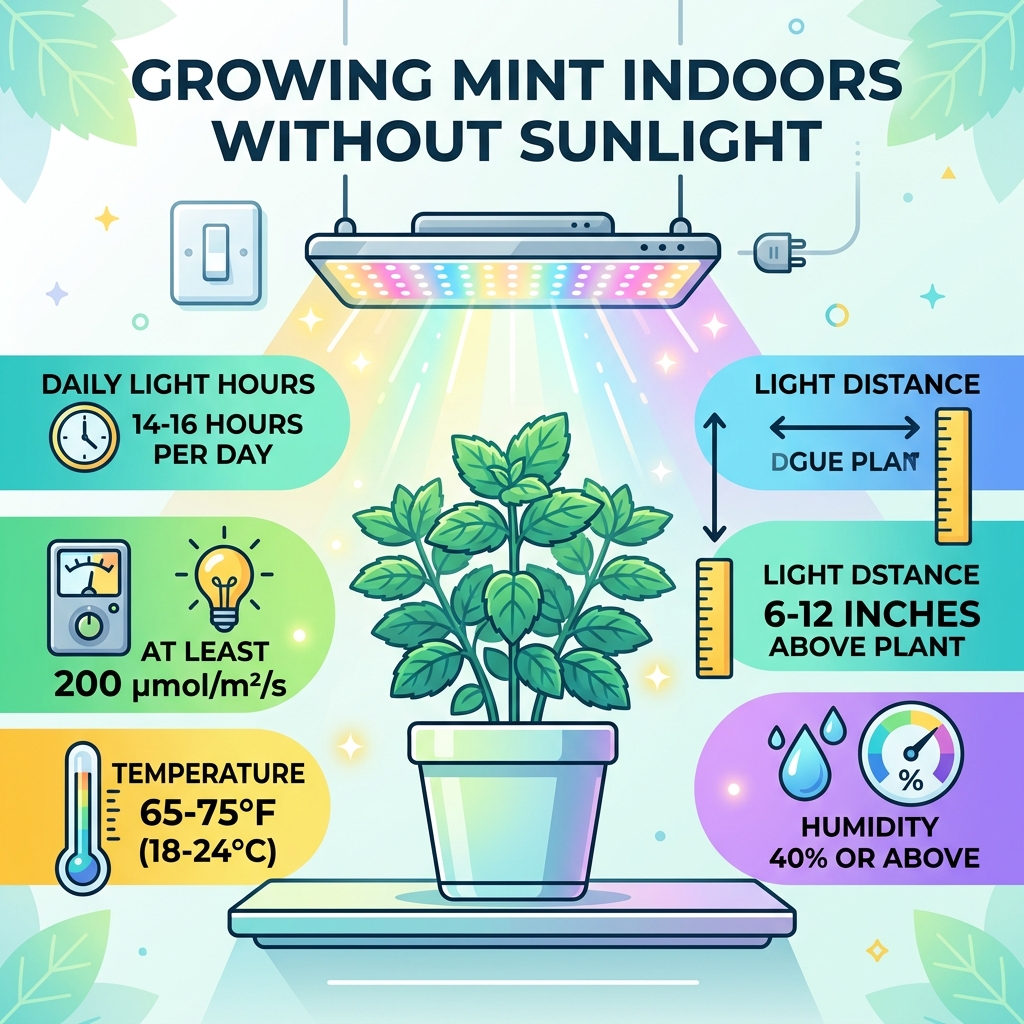
| What You Need | Details |
|---|---|
| Light source | Full-spectrum LED grow light |
| Daily light hours | 14-16 hours per day |
| Light intensity | At least 200 µmol/m²/s (PPFD) |
| Light distance | 6-12 inches above the plant |
| Temperature | 65-75°F (18-24°C) |
| Humidity | 40% or above |
Mint is one of the most forgiving herbs you can grow. It naturally tolerates shade — in the wild, it often spreads under taller plants where light is limited. That adaptable quality makes it a solid candidate for windowless rooms, dark apartments, and kitchen counters far from any window.
That said, there’s a catch. Typical room lighting — a desk lamp or ceiling bulb — won’t cut it. Mint needs a dedicated grow light to stay healthy, compact, and flavorful without sunlight.
The good news? Setting it up is simpler than you might think.
Can Mint Grow Indoors Without Sunlight?
When we ask, can mint grow indoors without sunlight, we are really asking if a plant can survive on a “synthetic diet” of photons. The answer is a resounding yes. Mint possesses an incredibly adaptable metabolism. In its natural habitat, mint often creeps along the damp, shaded floors of forests or near riverbanks, tucked away under the canopy of larger trees. This inherent shade tolerance is its superpower when it comes to indoor gardening.
Photosynthesis doesn’t actually require the sun; it requires specific wavelengths of light that the sun happens to provide in abundance. By using artificial lights that mimic the solar spectrum, we can trick the mint into thinking it’s a sunny day in the middle of a windowless basement. This is a game-changer for those of us living in “garden-level” apartments (which is just a fancy real estate term for “mostly underground”) or for anyone wanting to how-to-start-an-indoor-herb-garden in a pantry or hallway.
However, we must remember that while mint is hardy, it isn’t immortal. Without the energy provided by light, the plant cannot produce the sugars it needs to grow. If you try to grow it in total darkness without a grow light, it will eventually become “leggy”—stretching its stems out like a desperate yoga practitioner reaching for a window—before eventually turning yellow and dying. To succeed, we must replace the sun with technology.
Choosing the Best Grow Lights for Mint
Not all light is created equal. If you’ve ever tried to grow a plant under a standard 60-watt incandescent bulb, you’ve likely seen it wither. That’s because those bulbs produce a lot of heat but very little of the “blue” and “red” light frequencies that plants crave.
When we are setting up a system where mint grows entirely without natural light, we need to look at three main options:
- Full-Spectrum LED Grow Lights: These are our top recommendation. They are highly energy-efficient, produce very little heat, and provide a balanced spectral output that covers everything from seedling growth to leaf production. Modern LEDs can provide 200–400 PPFD (Photosynthetic Photon Flux Density), which is the perfect “sweet spot” for mint.
- Fluorescent T5 Lights: These were the industry standard for years. They are affordable and effective, but they aren’t as energy-efficient as LEDs. If you use these, they need to remain on for at least 12–14 hours per day to compensate for their lower intensity.
- Incandescent Bulbs: Avoid these. They provide only 30–80 PPFD, which is insufficient for anything other than keeping a plastic plant dusty.
LED vs. Fluorescent vs. Incandescent for Mint
| Feature | Full-Spectrum LED | Fluorescent (T5) | Incandescent |
|---|---|---|---|
| PPFD (Intensity) | 200–400 µmol/m²/s | 100–250 µmol/m²/s | 30–80 µmol/m²/s |
| Wattage | 30–50 Watts | 40–65 Watts | 60–100 Watts |
| Lifespan | 50,000 hours | 20,000 hours | 1,000 hours |
| Heat Output | Low | Medium | High |
| Best For | Total growth | Seedlings/Supplements | Not recommended |
For more detailed technical specs, check out our guide on grow-lights-for-indoor-herbs.
Ideal Intensity and Distance for Growing Mint Indoors Without Sunlight
Distance matters. If the light is too far away, the mint will stretch and become weak. If it’s too close, you might actually scorch the delicate leaves.
For a standard 20-40W LED grow light, we recommend a distance of 6 to 12 inches from the top of the foliage. At this range, the plant receives an intensity of roughly 200-400 µmol/m²/s. Since we are growing without any help from a window, we need to be diligent about heat management. Even though LEDs are “cool,” they can still build up heat in a small, unventilated space.
We suggest using a small fan to keep air moving. This not only prevents heat stress but also strengthens the mint’s stems by mimicking a light breeze. For more on positioning, see grow-lights-for-indoor-herbs-2.
Daily Light Duration for Mint Without Natural Light
Since artificial light is generally less intense than the raw power of the sun (which can provide 500–1,000 PPFD on a clear day), we make up for the lower intensity with duration.
Mint requires 14 to 16 hours of artificial light daily when grown in a windowless environment. This long “day” ensures the plant has enough time to complete its photosynthetic cycle. We strongly recommend using a cheap plug-in timer. Consistency is key; plants have a circadian rhythm just like we do. If the “sun” comes up at 6 AM one day and noon the next, your mint will get stressed and grow poorly. You can find more timing tips at grow-lights-for-indoor-herbs-3.
Setting Up Your Indoor Mint Environment
Growing mint in a windowless room is about more than just lights; it’s about creating a tiny ecosystem.

- Temperature: Mint is a fan of the “Goldilocks” zone. It prefers daytime temperatures between 65°F and 75°F (18-24°C). At night, it can handle a slight drop to 55°F, but try to keep it away from cold drafts or heating vents that can “crisp” the leaf edges.
- Humidity: Most homes are quite dry, especially in winter. Mint loves humidity levels of 40% or higher. If your leaves look a bit sad and dry, try placing the pot on a pebble tray filled with water or using a small humidifier.
- Containers: Use a pot that is at least 8 to 12 inches wide. Mint is a spreader; it grows horizontally via “runners.” Ensure the pot has excellent drainage holes. Terracotta is a great choice because it allows the soil to “breathe,” though it does dry out faster than plastic or ceramic.
To dive deeper into the hardware side of things, read our indoor-herb-garden-setup-tips.
Soil vs. Hydroponics: Can Mint Grow Indoors Without Sunlight Better in Water?
This is a hot debate in the gardening world.
Soil Growing: Using a well-draining potting mix (ideally 1/3 peat/coir, 1/3 compost, and 1/3 perlite) is the traditional way. It’s forgiving and provides a buffer for nutrients.
Hydroponics: Growing mint in water or a nutrient-rich solution is actually highly effective for indoor, light-deprived environments. Hydroponic systems allow for faster nutrient absorption, which can lead to quicker growth. Because there is no soil, you also eliminate the risk of soil-borne pests like fungus gnats.
If you’re a beginner, a small indoor-gardening-kits-for-beginners might be the easiest way to start your hydroponic journey.
Essential Care and Maintenance for Artificial Light Gardens
Once your setup is running, the daily “work” begins. Fortunately, mint is low-maintenance.
- Watering: Check the soil daily. Stick your finger an inch into the soil; if it feels dry, it’s time to water. In a windowless room, water evaporates slower than it does in a sunny window, so be careful not to overwater. Avoid letting the plant sit in a saucer of standing water, as this leads to root rot.
- Fertilizing: Mint grown under lights is in a constant state of growth. Feed it a balanced, water-soluble fertilizer at half-strength every 4–6 weeks. If you are using hydroponics, follow the specific nutrient schedule for your kit.
- Pruning and Harvesting: This is the most important part! To keep mint from getting leggy, you must prune it. When the stems reach about 6 inches tall, snip them just above a leaf node (the spot where leaves emerge). This encourages the plant to branch out and become “bushy” rather than tall and spindly. Never harvest more than one-third of the plant at a time.
Check out our list of the best-herbs-to-grow-indoors to see how mint compares to other light-loving plants.
Troubleshooting Common Indoor Mint Problems
Even with the best intentions, things can go wrong. Here is how to fix the most common issues:
- Leggy Growth: If your mint looks like it’s trying to win a high-jump competition, it’s not getting enough light. Move the grow light closer (aim for 6 inches) or increase the “on” time to 16 hours.
- Yellow Leaves: This is usually a sign of overwatering or poor drainage. Let the soil dry out more between waterings.
- Fungus Gnats: These tiny black flies love damp soil. Let the top two inches of soil dry out completely to kill the larvae, or use yellow sticky traps.
- Powdery Mildew: If you see white, flour-like spots on the leaves, your air circulation is poor. Add a small fan to the room.
For more layout and health tips, visit indoor-herb-garden-layout-tips.
Frequently Asked Questions about Growing Mint Indoors
Does mint grown under artificial lights taste the same?
Yes, provided you use a full-spectrum light. The flavor and aroma of mint come from its essential oils (menthol and pulegone). These oils are produced in higher concentrations when the plant receives the full range of light colors, especially blue light. If the light is too weak, the mint might taste “watered down” or less pungent.
What are the best mint varieties for low-light conditions?
While all mints are fairly hardy, some perform better in artificial setups:
- Peppermint: High menthol content, very hardy.
- Spearmint: The classic choice for mojitos and salads.
- Chocolate Mint: A fun variety that smells like a peppermint patty.
- Apple Mint: Has larger, fuzzier leaves that are great at catching light.
Find out more about best-indoor-herbs-for-cooking.
Can I use a regular desk lamp to grow mint?
Technically, you can, but you shouldn’t. A regular LED desk lamp lacks the intensity (lumen output) and the specific color temperature (usually 5000K-6500K) needed for photosynthesis. You might keep the plant alive for a few weeks, but it won’t thrive or produce enough leaves for a harvest. Invest in a specialized horticultural bulb—they often fit into standard lamp sockets and are much more effective.
Conclusion
At FinCapitaly, we believe that everyone should have access to the joy of fresh herbs, regardless of their home’s architectural flaws or lack of windows. Growing mint indoors without sunlight is not only possible; it’s a rewarding way to bring life and a crisp, invigorating aroma into your living space.
By choosing a quality full-spectrum LED, maintaining a consistent 14-16 hour light cycle, and keeping your plant pruned and hydrated, you can enjoy a year-round harvest of peppermint or spearmint. It’s a fantastic confidence-building project for any aspiring gardener. So, don’t let a dark room stop you—plug in a light and get growing!
For more tips on sustainable indoor living, visit us at https://www.fincapitaly.com/.
