
When Your Herb Garden Is the Victim: What Herbicide Drift Herb Damage Really Means
Herbicide drift herb damage happens when weed-killing chemicals travel through the air and land on plants that were never meant to be sprayed — like your basil, mint, or parsley.
Here’s a quick summary of what to know:
- What it is: Herbicides move off-target as tiny droplets (particle drift) or invisible vapor (vapor drift/volatilization)
- Common causes: Nearby farm or lawn spraying, contaminated mulch or compost, right-of-way weed control
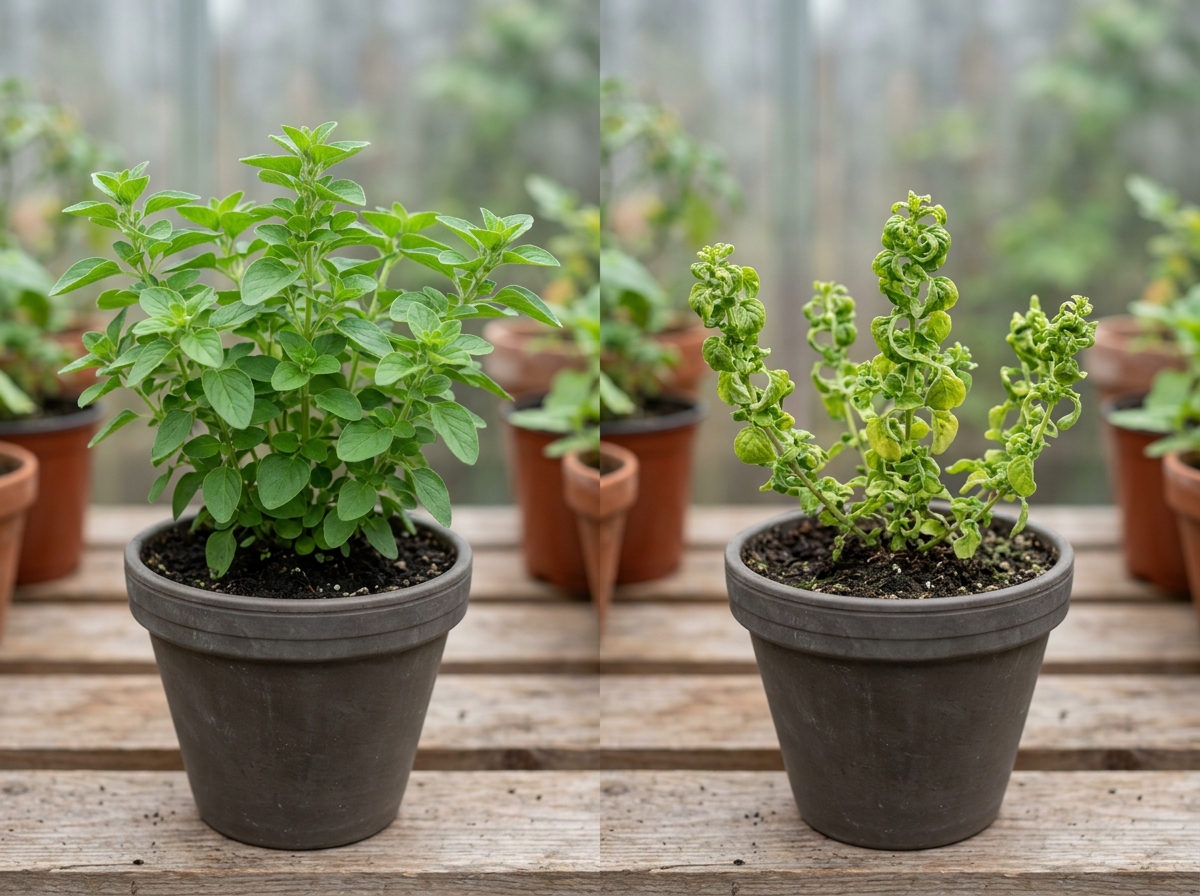
- Key symptoms: Twisted or cupped leaves, leaf curling, strappy growth, yellowing, stunted plants
- Most at risk: Tomatoes, basil, peppers, grapes, and beans — some are damaged at doses 100 times lower than normal weed-control rates
- What to do: Remove affected edible plants, document the damage, and do not eat produce from injured plants
Herbicide drift is not just a problem for large farms. It can reach your backyard herb garden from miles away — sometimes without you ever knowing a spray was applied nearby.
One real-world example makes this painfully clear. A group of Master Gardeners found that roughly 25% of their exterior tomato plants were showing signs of drift damage — while plants deeper inside the garden were completely unaffected.
That pattern — damage on the outside, healthy plants in the center — is one of the most telling clues that drift is the culprit.
And the problem is growing. The EPA estimated that dicamba-related drift incidents were underreported by approximately 25 times in 2021 alone. Many gardeners never connect the strange leaf curling or stunted growth to a herbicide drifting in from somewhere else entirely.
If your herbs are looking twisted, cupped, or just wrong — and you can’t figure out why — drift may be the answer.

Identifying Herbicide Drift Herb Damage Symptoms
Identifying herbicide drift herb damage can feel like playing detective. Unlike a hungry caterpillar that leaves a clear bite mark, herbicides change the very way a plant grows. We often see symptoms appear within a few hours to a week after exposure, depending on the chemical involved.
The most common sign is something called epinasty. This is a fancy botanical term for downward bending or twisting of the leaves and stems. Your basil might look like it’s trying to tie itself in knots. Other classic signs include:
- Leaf Curling and Cupping: Leaves may curl upward or downward, forming a “cup” shape. Dicamba is famous for causing this upward cupping.
- Strapping: This is when leaves become unnaturally long and narrow, often with veins that run parallel to each other rather than in a net-like pattern.
- Chlorosis: You might notice yellowing between the veins or along the leaf margins.
- Stunting: The plant simply stops growing, or the new growth emerges tiny and deformed.
According to the Herbicide injury on garden plants | UMN Extension, these symptoms are often “abiotic,” meaning they aren’t caused by a living organism like a fungus or bacteria. This is why it’s so important to look at the whole garden. If your mint, rosemary, and the weeds in the cracks of your sidewalk all look twisted at the same time, you’re likely looking at drift.
Why Tomatoes and Grapes Signal Herbicide Drift Herb Damage
If you grow tomatoes or grapes near your herb garden, consider them your “canaries in the coal mine.” These plants are incredibly sensitive to growth-regulator herbicides like 2,4-D and dicamba.
In fact, grapes can be damaged by 2,4-D at rates up to 100 times less than what is used to actually kill weeds! Tomatoes are similarly sensitive to glyphosate (the active ingredient in Roundup), showing damage at levels 100 times lower than labeled rates.
As noted by Herbicide Drift and Drift Related Damage | Penn State Extension, a single instance of 2,4-D drift on a grape plant can ruin or prevent a harvest for two to three years. If your tomato leaves are “strappy” (narrow and elongated) or your grape leaves look like fans with jagged edges, it’s a massive red flag that your herbs have also been exposed.
Distinguishing Drift from Environmental Stress
Before we panic and start pulling plants, we need to rule out other issues. Herbs can be dramatic!
- Heat Curling: During a heatwave, leaves might curl to protect themselves. The difference? Heat-curled leaves can usually be flattened out by hand without breaking. Herbicide-damaged leaves are often physically distorted and “leathery”—they won’t flatten.
- Drought Stress: Wilting from thirst usually affects the whole plant uniformly. Drift often hits one side of the plant (the side facing the wind) more than the other.
- Sucking Insects: Aphids or mites can cause leaf distortion. Always check the undersides of the leaves for tiny pests or sticky residue (honeydew).
- Mosaic Viruses: These cause mottled yellow patterns and stunted growth. However, viruses usually affect only one type of plant (e.g., just the peppers), whereas drift affects a wide range of species simultaneously.
Common Chemicals and Susceptible Indicator Plants
The “Big Three” herbicides we usually deal with in drift cases are 2,4-D, Dicamba, and Glyphosate.
2,4-D and Dicamba are “growth regulators” or phenoxy herbicides. They mimic plant hormones, causing the plant to grow so fast and uncontrollably that it literally grows itself to death. These are the chemicals most likely to cause that signature twisting and cupped appearance.
Glyphosate, on the other hand, is non-selective. It doesn’t cause as much twisting; instead, it causes yellowing (chlorosis) that starts at the base of the new leaves and works its way out, eventually leading to browning and death.
As the Mitigating Herbicide Damage to Specialty Crops: Herbicide Drift | LSU AgCenter explains, these chemicals have different “vapor pressures.” Some are much more likely to turn into a gas and float away than others.
Sources of Herbicide Drift Herb Damage
You might think, “I don’t live near a farm, so I’m safe!” Unfortunately, drift doesn’t care about property lines. Common sources include:
- Nearby Farms: Large-scale applications of dicamba or 2,4-D on corn or soybean fields can travel miles.
- Lawn Care Services: If a neighbor has their lawn treated for dandelions on a windy day, your herbs could pay the price.
- Contaminated Mulch and Compost: Some herbicides (like aminopyralid) can survive the digestive tract of a cow and the composting process. If you buy manure or hay-based mulch that was treated, your plants will show symptoms as soon as their roots touch the soil.
- Right-of-Way Spraying: Utilities and highway departments often spray under power lines or along roadsides to keep brush down.
Weather Conditions and Drift Distance
Weather is the biggest factor in whether a spray stays put or travels.
- Wind Speed: Ideally, herbicides should only be applied when winds are between 3 and 10 mph. Anything higher causes particle drift (droplets blowing away).
- Temperature Inversions: This is a sneaky one. On calm, clear nights, a layer of warm air can trap a “cloud” of herbicide near the ground. This cloud can then drift for miles as a concentrated mass.
- Volatilization: When temperatures hit 80°F or higher, certain herbicides can turn from a liquid into a gas (vapor drift). This vapor can travel 2 to 3 miles or more from the original site.
Food Safety and Managing Affected Herb Crops
This is the hardest part for any gardener to hear: If your edible herbs show signs of herbicide drift, you should not eat them.
We know, it’s heartbreaking. You’ve spent months nurturing that Thai basil or rosemary. But the safety risks are real. Because we don’t know exactly which chemical drifted onto the plants, or at what concentration, we cannot guarantee they are safe to consume.
Herbicides like glyphosate and 2,4-D are systemic, meaning they move through the entire plant’s “bloodstream.” Washing the leaves won’t remove the chemical that has already been absorbed. Furthermore, using these chemicals on herbs is often “off-label,” meaning there is no data on what a safe residue level would be for human consumption.
The Integrated Pest Management | University of Missouri suggests that the safest course of action is to remove the affected plants entirely.
Immediate Steps for Herbicide Drift Herb Damage Recovery
If you catch the drift as it is happening (perhaps you see the neighbor’s spray rig and smell the chemicals), you might be able to save some plants.
- Foliage Washing: If you can rinse the plants with a heavy stream of water within minutes (ideally within 3 or 4 hours), you may dilute the chemical before it’s absorbed.
- Activated Charcoal: For soil-applied herbicides or heavy run-off, incorporating activated charcoal into the soil can help “tie up” the chemical and prevent the roots from drinking it.
- Patience for Perennials: While you shouldn’t eat the leaves this year, perennial herbs like lavender or sage might recover next year. If the new growth emerges healthy and normal-looking, the plant may have processed the sub-lethal dose. However, for annuals like cilantro or basil, it’s best to pull them and start over.
According to the Mitigating Herbicide Damage to Speciality Crops – Action Plan | LSU AgCenter, you should document the progression of symptoms with photos every few days to see if the plant is recovering or declining.
Testing for Contamination at Home
If you suspect your soil or compost is contaminated with herbicide residue (herbicide carryover), you can perform a simple “bioassay” at home.
- The Pea/Bean Test: Peas and beans are very sensitive to herbicides.
- How to do it: Fill a few small pots with your suspect soil and a few with “clean” potting soil as a control. Plant 3-4 pea or bean seeds in each.
- Observation: Grow them for about 3 weeks. If the plants in the suspect soil come up twisted, yellowed, or with “strappy” leaves while the control plants look fine, your soil is contaminated.
Prevention Strategies and Reporting Procedures
We can’t control our neighbors, but we can build a “fortress” for our herbs.
- Windbreaks and Buffers: Planting a thick row of non-edible evergreens or tall shrubs can physically catch drifting droplets before they hit your herbs.
- Communication: Talk to your neighbors! Most people don’t want to kill your garden. Let them know you have a sensitive herb garden and ask them to avoid spraying on windy days or during temperature inversions.
- DriftWatch: If you are a commercial grower or have a significant specialty crop, register with DriftWatch. This is a map that pesticide applicators check before they spray to see where sensitive crops are located.
The Herbicide Injury and the Problem of Spray Drift | Ohioline emphasizes that knowing the rules—like wind speed limits on labels—can help you have a more informed conversation with local farmers or lawn companies.
How to Document and Report Incidents
If you’ve suffered significant herbicide drift herb damage, you have the right to report it. This helps state agencies track problem areas and can hold negligent applicators accountable.
- Photo Documentation: Take clear, high-resolution photos of the damage. Include “wide shots” showing the pattern across the garden and “close-ups” of the distorted leaves.
- Log the Weather: Write down the wind speed, direction, and temperature on the day you suspect the drift occurred.
- Contact Authorities: Report the incident to your State Department of Agriculture. They can send an inspector to take official tissue samples.
- EPA Reporting: You can also report incidents to the EPA’s Ecological Pesticide Incident Reporting portal.
As the Xerces Society points out, reporting is vital because many incidents go unrecorded, making it harder to advocate for better pesticide regulations.
Frequently Asked Questions about Herbicide Drift
Can plants recover from herbicide drift?
It depends on the dose. If the plant received a “sub-lethal” dose, it might grow out of it. You’ll know it’s recovering if the newest leaves start coming out looking normal. However, even if it recovers, the yield is usually much lower, and for edible herbs, the safety of the residue remains a concern for that growing season.
How far can herbicide vapor drift travel?
Vapor drift is the long-distance traveler. While particle drift usually stays within a few hundred feet, vaporized dicamba or 2,4-D can travel 2 miles or more under the right conditions (high heat and low humidity).
Why is herbicide drift becoming a bigger problem?
The rise of GMO crops designed to be resistant to dicamba and 2,4-D has led to a massive increase in the use of these specific, highly volatile chemicals during the late spring and summer—exactly when our herb gardens are most vulnerable.
Conclusion
Protecting your garden from herbicide drift herb damage requires a mix of vigilance, communication, and sometimes, the hard decision to pull a crop for safety. By understanding the symptoms and the science behind drift, we can better defend our green spaces.
If you’re tired of battling the elements outdoors, you might consider moving some of your most sensitive plants inside. Check out our indoor herb garden setup tips to learn how to create a drift-free sanctuary for your favorite flavors. At FinCapitaly, we believe every gardener deserves a harvest that is both beautiful and safe. Stay observant, keep those buffers high, and let’s keep our gardens growing strong!
