
Why Getting Your Hydroponic Basil Nutrient Solution Right Makes All the Difference
A hydroponic basil nutrient solution is the water-based mix of minerals your basil plants feed on instead of soil. Get it right, and you’ll have lush, flavorful basil ready to harvest in as little as 3–4 weeks indoors.
Here’s what basil needs at a glance:
| Nutrient | Target Level |
|---|---|
| Nitrogen (N) | 150 ppm |
| Phosphorus (P₂O₅) | 25–35 ppm |
| Potassium (K₂O) | 125 ppm |
| Calcium (Ca) | 80 ppm |
| Magnesium (Mg) | 60 ppm (preferred) |
| pH | 5.5–6.8 |
| Electrical Conductivity (EC) | 1.0–1.6 mS/cm |
Basil is one of the most popular herbs grown hydroponically — and for good reason. It grows fast, smells incredible, and thrives without soil when fed the right nutrients. But it’s also more demanding than many other herbs, especially when it comes to magnesium.
Get the nutrient balance wrong and you’ll see yellowing leaves, stunted growth, or a flat, weak flavor. Get it right and your basil will grow vigorously, smell aromatic, and taste exactly like it should.
This guide walks you through everything — from exact nutrient targets to managing deficiencies and keeping your reservoir clean.
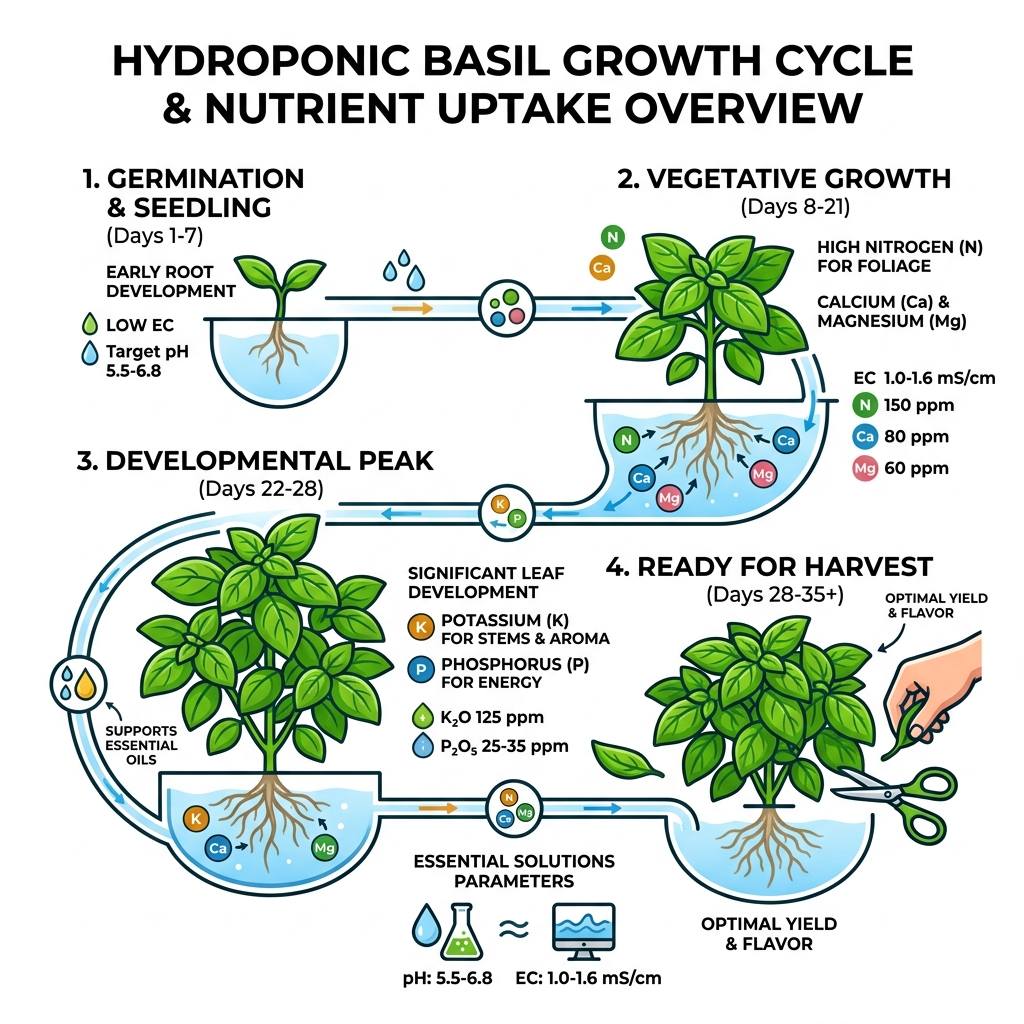
Optimal Hydroponic Basil Nutrient Solution Composition
When we talk about growing the perfect batch of Genovese or Thai basil, we have to look closely at what is happening in the water. Unlike lettuce, which is relatively “light” on its feet, basil is a heavy lifter. It requires a more robust mineral profile to produce those essential oils that give it that signature punchy aroma.
Research indicates that the impact of nutrient solutions on basil yield and safety is profound. If the ion concentration is too high, you might actually see a decrease in fresh weight. On the flip side, if it’s too low, the plant becomes “leggy” and lacks flavor. To help you visualize the difference, we’ve compared basil’s needs to the industry standard for leafy greens:
| Nutrient (ppm) | Basil Target | Lettuce Target |
|---|---|---|
| Nitrogen (N) | 150 | 120 |
| Phosphorus (P) | 35 | 40 |
| Potassium (K) | 125 | 210 |
| Calcium (Ca) | 80 | 60 |
| Magnesium (Mg) | 60 | 40 |
As you can see, basil is particularly hungry for Calcium and Magnesium. If you’re transitioning from growing bibb lettuce to herbs, you’ll want to check out our Indoor Herb Fertilizer Guide to ensure you aren’t underfeeding your aromatic crops.
Macronutrient and Micronutrient Targets for a Hydroponic Basil Nutrient Solution
To build a truly effective hydroponic basil nutrient solution, we need to look at the full spectrum of elements. These are divided into macronutrients (the “big” stuff) and micronutrients (the “trace” stuff).
- Nitrogen (N): This is the engine of leaf growth. We aim for 150 ppm. Too little and your leaves turn pale; too much and the plant becomes overly soft and susceptible to pests.
- Phosphorus (P): Vital for root development and energy transfer. We keep this between 25-35 ppm.
- Potassium (K): This regulates the plant’s “breathing” (stomata) and water use. 125 ppm is our sweet spot.
- Calcium (Ca) & Magnesium (Mg): These are the “structure” nutrients. Calcium builds strong cell walls, while Magnesium is the heart of the chlorophyll molecule. Basil is a known “Magnesium hog,” requiring up to 60 ppm compared to the 40 ppm usually found in standard mixes.
- Micronutrients: Don’t let the name fool you; these are essential. Iron (Fe) prevents yellowing between the veins, while Boron (B), Zinc (Zn), Manganese (Mn), Copper (Cu), and Molybdenum (Mo) handle everything from enzyme activation to protein synthesis.
When planting herbs without soil, you are the plant’s only source of food. Missing even one of these trace elements can lead to a total collapse of the plant’s metabolic system.
Ideal pH and EC Ranges for a Hydroponic Basil Nutrient Solution
Think of pH as the “gatekeeper” of nutrients. If the pH is off, the nutrients might be in the water, but the plant can’t “grab” them. This is called nutrient lockout.
- Ideal pH Range: 5.5 to 6.8. Most experts prefer staying between 5.8 and 6.2 for the best absorption of Magnesium and Phosphorus.
- Electrical Conductivity (EC): This measures the “saltiness” or strength of your solution. For basil, we recommend an EC between 1.0 and 1.6 mS/cm (or a Conductivity Factor/CF of 10–16).
If your EC climbs above 1.6, some growers find that basil begins to take on a mint-like flavor rather than its traditional peppery sweetness. Keeping your EC stable is a core part of indoor herb growth troubleshooting. If the water evaporates but the plants don’t eat all the nutrients, the EC will spike, potentially “burning” the roots.
Managing Magnesium and Common Nutrient Deficiencies
Magnesium deficiency is the “Achilles’ heel” of hydroponic basil. Because basil grows so fast and produces so much chlorophyll, it often runs out of Magnesium before anything else.
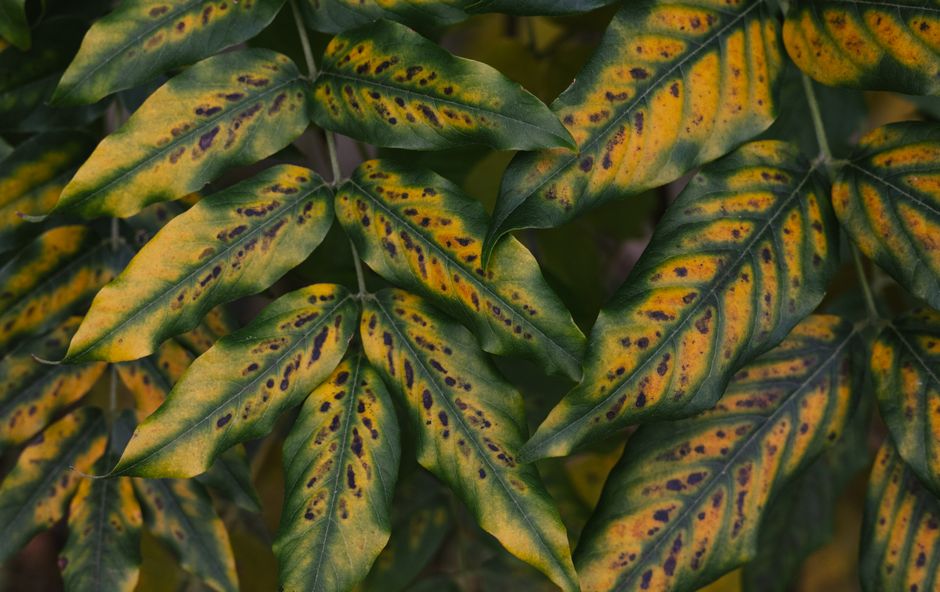
How to spot Magnesium deficiency: It usually starts on the older, lower leaves. You’ll see “interveinal chlorosis”—this is a fancy way of saying the leaf stays green along the veins but turns yellow in the spaces between them. If left unchecked, the yellowing moves up to the new growth, and the leaves may develop necrotic (dead) brown patches.
The Correction Strategy:
- Check the Ratios: Sometimes there is enough Magnesium in the water, but too much Potassium or Calcium is “blocking” it. We aim for a Ca:Mg ratio of 2:1 and a K:Mg ratio of 4:1.
- Epsom Salts (MgSO4): This is the quickest fix. Adding a small amount of Epsom salts can boost Mg levels. However, a word of caution: never mix concentrated Epsom salts with concentrated Calcium Nitrate in the same bucket, or they will react and turn into “gypsum” (basically solid gunk). Dilute them into the full reservoir separately.
- Tissue Analysis: If you’re growing commercially, a leaf tissue analysis can confirm if your levels are within the sufficiency range of 1–1.8%.
Learning how to care for basil indoors involves becoming a bit of a “plant detective,” watching those lower leaves for the first sign of trouble.
Preparing and Maintaining Your Nutrient Reservoir
The reservoir is the heart of your system. If the heart isn’t happy, the rest of the plant won’t be either.
Oxygen is Everything Basil roots love oxygen. Without it, they can develop root rot (Pythium). We always use an air pump and air stones to keep the water “bubbling.” This dissolved oxygen helps the roots absorb the hydroponic basil nutrient solution more efficiently.
Temperature Control The ideal water temperature is 68–72°F (20–22°C). If the water gets warmer than 80°F, it loses its ability to hold oxygen, and pathogens start to throw a party. If it gets colder than 60°F, the plant’s metabolism slows to a crawl, and it stops taking up nutrients.
The “Top-Off” vs. The “Change-Out” As your basil drinks, the water level drops. You can “top off” with fresh water to keep the level consistent, but every 2–3 weeks, you should perform a full reservoir change. Why? Because plants don’t eat nutrients in perfect ratios. Over time, the “leftovers” build up and can cause toxicities or lockouts. Regular changes prevent these invisible imbalances and help you avoid indoor herb watering mistakes.
Advanced Technologies and Algae Control
We are always looking for ways to push the boundaries of herb quality. One of the most exciting developments in the field is the use of Plasma-Activated Nutrient Solution (PANS).
Recent research on PANS and basil growth has shown incredible results. By treating the nutrient solution with cold plasma, researchers increased basil fresh mass by up to 29% and dry mass by 45%. But the benefits don’t stop at growth:
- Algae Reduction: PANS can reduce algae concentration in reservoirs by up to 24%. Algae are more than just an eyesore; they steal nutrients and oxygen from your basil.
- Enhanced Aroma: Plasma treatment can increase levels of linalool, the compound responsible for that sweet, floral scent we love in fresh basil.
- Reactive Nitrogen Species: The process creates unique forms of nitrogen that the plant can use to grow taller and greener.
While plasma tech might be a bit advanced for a kitchen counter setup, the principle of preventing mold in indoor herb gardens remains the same: keep your water clean, keep your light out of the reservoir (algae need light to grow!), and ensure good airflow.
Frequently Asked Questions about Basil Nutrients
How often should I change my hydroponic basil nutrient solution?
For the best results, we recommend a full reservoir change every 14–21 days. While you can “top off” the water in between, a full refresh ensures that the mineral ratios stay balanced and prevents the buildup of unwanted salts or pathogens.
Why are my basil leaves turning yellow in a hydroponic system?
Yellowing (chlorosis) is usually a sign of one of three things:
- Nitrogen Deficiency: General yellowing of the whole plant.
- Magnesium Deficiency: Yellowing between the veins on older leaves.
- pH Imbalance: If your pH is above 7.0, the plant can’t take up Iron or Manganese, causing the new growth to turn yellow.
Can I use standard garden fertilizer for hydroponic basil?
We don’t recommend it. Standard garden fertilizers often rely on soil microbes to break down complex organic matter into a form plants can eat. In a hydroponic system, you need “chelated” nutrients that are immediately water-soluble. Using soil fertilizer in a reservoir usually results in a smelly, clogged mess and starving plants.
Conclusion
At FinCapitaly, we believe that growing your own food should be a rewarding, high-yield experience. Mastering your hydroponic basil nutrient solution is the single most important step in that journey. By maintaining a target of 150 ppm Nitrogen and a boosted 60 ppm of Magnesium, you ensure your basil isn’t just surviving—it’s thriving.
When you get the pH, EC, and mineral balance right, the rewards are immediate: vibrant green leaves, a heady aroma that fills the room, and a harvest that tastes better than anything you can buy at the store. Whether you are using a simple DWC bucket or a high-tech vertical system, the principles remain the same: feed the roots, oxygenate the water, and watch your garden grow.
Ready to level up your indoor garden? Start your indoor herb garden with FinCapitaly today and experience the difference that expert nutrient management can make. Happy growing!
