
Why Most Hydroponic Growers Struggle Without a Reliable pH Meter
A ph meter for hydroponics is one of the most important tools you can own as an indoor grower — and skipping it is one of the fastest ways to kill an otherwise healthy plant.
Here are the best types of pH testing tools, matched to your experience level:
| Grower Level | Best Tool Type | Key Benefit |
|---|---|---|
| Beginner | Liquid test kit (4.0-8.5 range) | Affordable, simple to use |
| Intermediate | Digital pH pen (±0.1 accuracy) | Fast, reusable, waterproof |
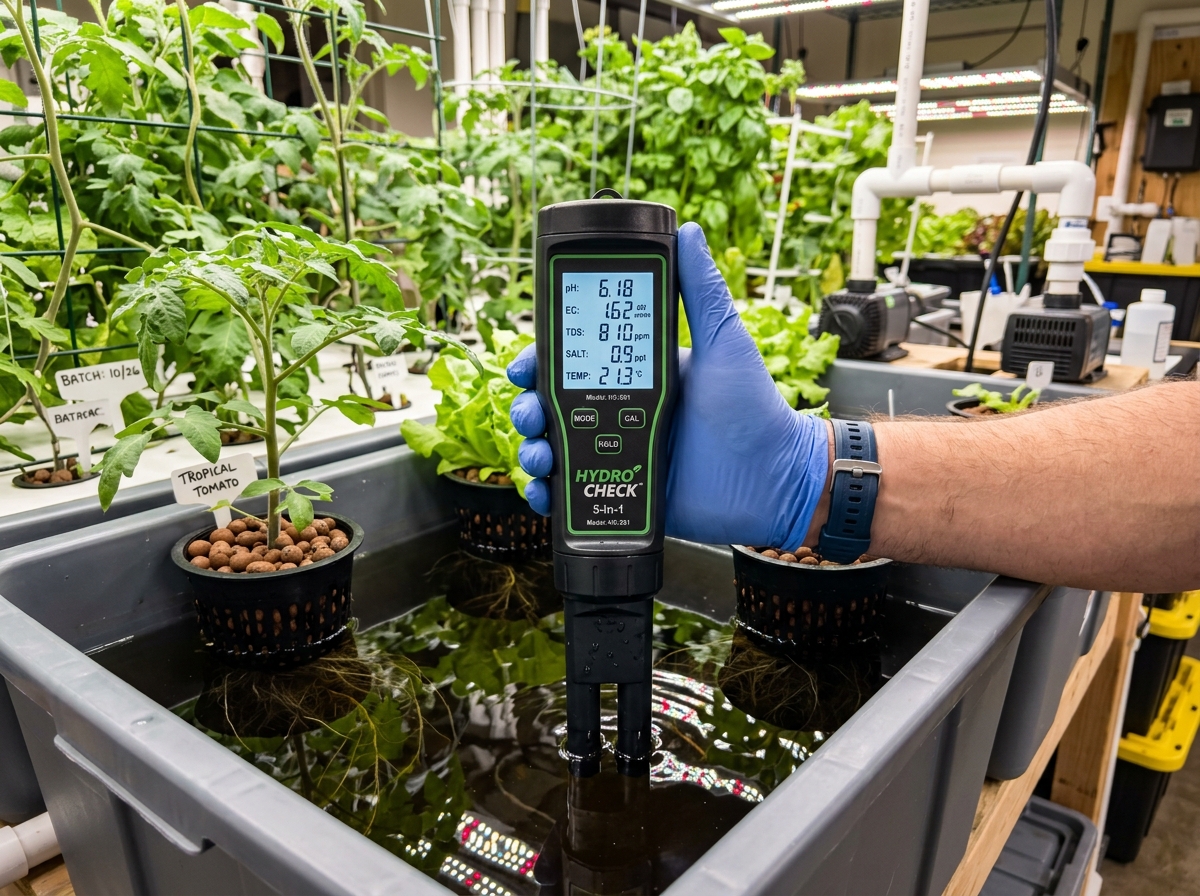
| Advanced | Multi-parameter meter (±0.01 accuracy) | Measures pH, EC, TDS, and temperature |
Most hydroponic plants need a pH between 5.5 and 6.5 to absorb nutrients properly. Outside that range, nutrients become unavailable to roots — even if they’re physically present in the water. This is called nutrient lockout, and it’s more common than most beginners expect.
pH can shift daily in a hydroponic reservoir. Without a reliable way to test it, you’re essentially growing blind.
Whether you’re growing fresh basil on your kitchen counter or running a full indoor herb setup, knowing your water’s pH takes the guesswork out of the equation entirely.

Why pH is Crucial for Hydroponic Success
To understand why we need a ph meter for hydroponics, we first have to look at the chemistry happening inside your reservoir. pH stands for “potential Hydrogen,” and it measures the acidity or alkalinity of your nutrient solution on a scale of 0 to 14.
This scale is logarithmic, which is a fancy way of saying that a pH of 6.0 is ten times more acidic than a pH of 7.0. If your reservoir drops from 6.0 to 5.0, your plants are suddenly sitting in water that is 100 times more acidic!
Nutrient Solubility and “Lockout”
Plants don’t “eat” solid food; they “drink” mineral ions dissolved in water. The pH level determines whether those minerals stay dissolved or turn into solids that the plant cannot use. In the ideal range of 5.5 to 6.5, essential elements like Nitrogen, Phosphorus, and Potassium are at their peak availability.
If the pH climbs too high (alkaline), iron and manganese “lock out,” leading to yellowing leaves. If it drops too low (acidic), micronutrients can actually become toxic to the plant. Maintaining this balance is the secret to planting-herbs-without-soil successfully. Without a stable pH, even the most expensive nutrients in the world won’t help your garden grow.
Choosing the Best ph meter for hydroponics: Key Features to Compare
When we go shopping for a ph meter for hydroponics, it’s easy to get overwhelmed by the options. Do you go with a cheap $10 pen or a $300 continuous monitor? The right choice depends on your budget and how much time you want to spend maintaining your gear.
| Feature | Liquid Test Kits | Digital pH Pens | Continuous Monitors |
|---|---|---|---|
| Accuracy | Moderate (Color-based) | High (±0.1 to ±0.01) | Very High (Lab-grade) |
| Maintenance | None | Regular calibration | Monthly calibration |
| Speed | 1-2 minutes | 10-30 seconds | Instant/Always on |
| Price | $ | $$ | $$$ |
Must-Have Features for Digital Meters
If you decide to go digital, there are a few non-negotiable features we recommend:
- Automatic Temperature Compensation (ATC): pH readings change based on the temperature of the water. ATC ensures the meter adjusts its math so you get an accurate reading whether your reservoir is 65°F or 75°F.
- IP67 Waterproofing: Let’s be honest — at some point, you will drop your meter in the tank. An IP67 rating means it can survive a dunk without becoming a paperweight.
- Replaceable Probes: The sensor on a pH meter (the glass bulb) has a limited lifespan. High-quality meters allow you to swap the probe for a new one rather than buying a whole new device.
- Multi-Parameter Readings: Many modern meters also measure EC (Electrical Conductivity) and TDS (Total Dissolved Solids). Having one tool that does it all saves a lot of time during daily checks.
Top-Rated Testing Tools for Every Grower Level
As we progress in our gardening journey, our tools should grow with us. A beginner might only need a simple color-match kit, while a commercial-scale grower needs 24/7 data streaming to their phone.
Best Budget ph meter for hydroponics for Beginners
For those just starting out, a wide-spectrum liquid indicator kit is often the best move. These kits usually cover a range of 4.0 to 8.5. You simply fill a small vial with your nutrient solution, add a few drops of the indicator liquid, and compare the color of the water to a chart.
- Pros: It’s nearly impossible to “break” a liquid kit. They never need calibration and are extremely cost-effective.
- Cons: It can be hard to tell the difference between a pH of 6.0 and 6.5 just by looking at a shade of green or yellow.
Professional Grade ph meter for hydroponics for Advanced Systems
If you have a large Deep Water Culture (DWC) or Nutrient Film Technique (NFT) system, you need lab-grade precision. These professional tools often feature lithium glass membranes and double-junction probes, which are more resistant to “clogging” from thick organic nutrients.
Advanced monitors often stay submerged in the tank at all times, providing a constant backlit display of your water’s health. Some even feature Bluetooth connectivity and 30-day calibration reminders so you never have to wonder if your data is accurate.
Maintenance and Calibration: Ensuring Long-Term Accuracy
A digital ph meter for hydroponics is a scientific instrument, not a “set it and forget it” tool. If you don’t maintain it, it will start giving you false readings, which is actually worse than having no meter at all!
The Calibration Process
Most digital meters require 2-point or 3-point calibration. This involves dipping the probe into “buffer solutions” with a known pH (usually 4.0, 7.0, and sometimes 10.0).
- Why it matters: Over time, the electrode inside the pen “drifts.” Regular calibration resets the baseline.
- Frequency: We recommend calibrating once a week for budget meters and once a month for high-end professional models.
Probe Care and Storage
The most important thing to remember is that the probe must never dry out. Most high-quality meters come with a cap that should be filled with KCL storage solution.
- Never use distilled water for storage: Distilled water will actually “suck” the ions out of the glass probe, ruining it.
- The Rinse: Always rinse your probe with distilled water after testing to remove nutrient salts, but always store it in KCL.
- Cleaning: If you notice a “biofilm” or slime building up on the probe, soak it in a specialized cleaning solution for 15-20 minutes to restore accuracy.
Frequently Asked Questions about Hydroponic pH Testing
What is the difference between pH, EC, and TDS?
Think of it this way: pH tells you if the plant can eat. EC (Electrical Conductivity) and TDS (Total Dissolved Solids) tell you how much food is in the water.
- EC/TDS measures the salt concentration of your nutrients.
- If your EC is too high, you might burn your plants; if it’s too low, they will be “hungry.”
- You need to monitor both to have a truly successful system.
How often should I check and adjust my pH levels?
When you are first setting up a system, you should check it daily. Once you become familiar with how your plants react to the nutrients, you can move to checking every other day. Always check the pH about 30-60 minutes after adding new nutrients or topping off the water.
Why does my pH level keep drifting in my reservoir?
pH drift is normal, but extreme swings are a red flag. Common causes include:
- Plant Uptake: As plants eat, they release ions back into the water, which shifts the pH.
- Water Hardness: High mineral content in your tap water can act as a “buffer,” making it hard to keep the pH down.
- Microbial Activity: If your reservoir is too warm or dirty, bacteria can grow, causing the pH to crash (drop below 4.0). Keeping a clean system is the best way to manage stability.
Conclusion
At FinCapitaly, we believe that data is the key to a bountiful harvest. Transitioning from “guessing” to “testing” is the single biggest step you can take to improve your plant yields and system stability. Whether you choose a simple liquid kit or a high-tech ph meter for hydroponics, the goal remains the same: creating the perfect environment for your plants to thrive.
Ready to take your indoor garden to the next level? Start by mastering your water chemistry today. For more tips on soil-free success, visit our resources at https://www.fincapitaly.com/.
