
Why Your Grow Light Spectrum Matters More Than You Think
Blurple spectrum herb grow setups are one of the most debated topics among indoor gardeners — and for good reason. Before you invest in lights for your kitchen herbs, here’s a quick answer to help you decide:
Quick Comparison: Blurple vs. Full-Spectrum LEDs for Herbs
| Factor | Blurple LEDs | Full-Spectrum White LEDs |
|---|---|---|
| Best for | Budget setups, flowering boost | All growth stages, mixed herb gardens |
| Spectrum | Red (660nm) + Blue (450nm) only | 400–750nm (mimics sunlight) |
| Energy efficiency | Good | Better (up to 3.5+ µmol/J) |
| Plant visibility | Poor (purple haze hides issues) | Easy to spot problems |
| Cost | Lower upfront | Higher upfront, lower long-term |
| Beginner-friendly | Yes, for single-stage grows | Yes, for all skill levels |
If you’re growing basil, mint, or other culinary herbs indoors, both options can work — but they come with real trade-offs.
Blurple lights focus on just two wavelengths: red and blue. They were the first wave of LED grow technology, built around the idea that plants mostly absorb red (~660nm) and blue (~450nm) light for photosynthesis. That’s true — but it’s not the whole story.
Modern research shows that green light penetrates deeper into plant canopies, and far-red light can boost flowering through something called the Emerson Enhancement Effect. Blurple lights skip all of that.
As one grower put it bluntly: “Blurples make for shit pictures. Absolute torture.” — and beyond the photography problem, that purple haze makes it genuinely hard to spot yellowing leaves or pest damage on your herbs.
Still, plenty of skilled home growers pull impressive harvests from blurple setups. The light is one piece of the puzzle — not the whole game.
Here’s what you need to know to choose wisely.
Understanding the Blurple Spectrum Herb Grow
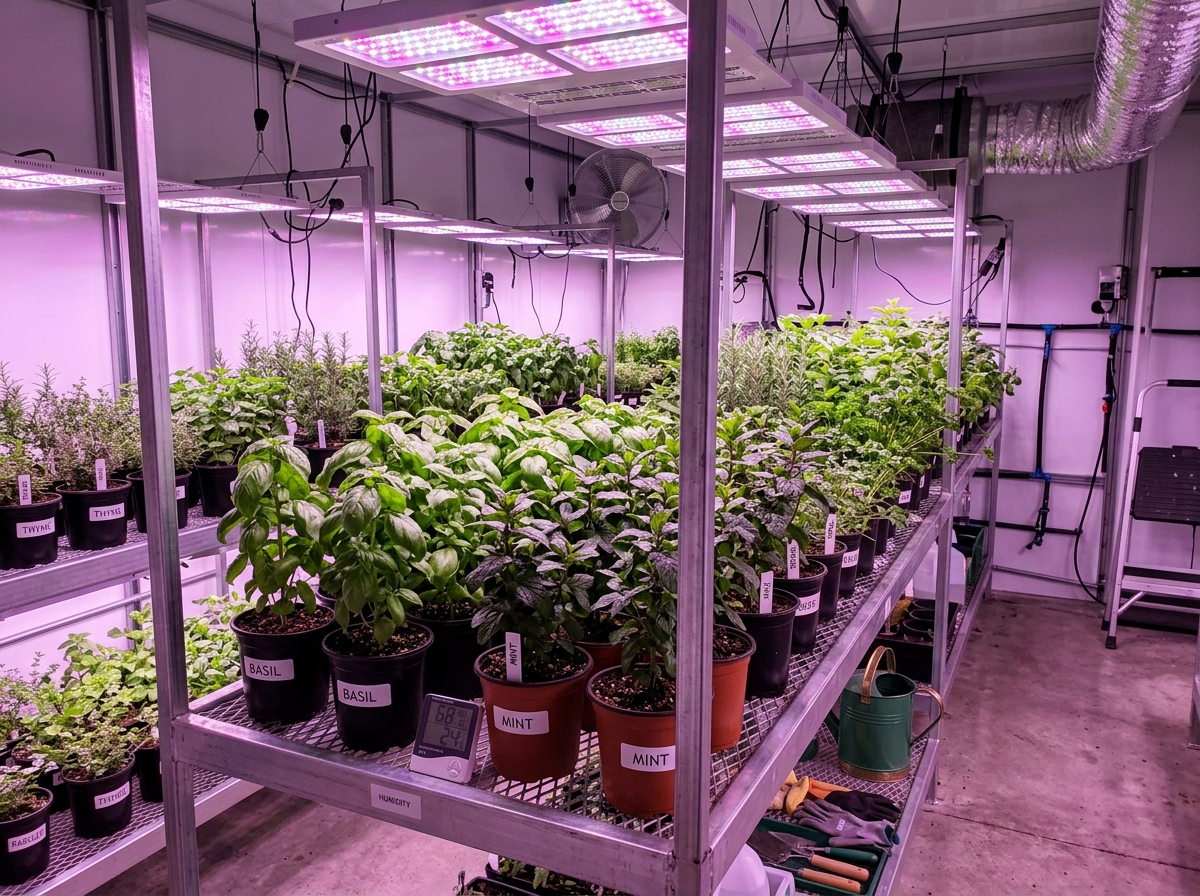
When we talk about a blurple spectrum herb grow, we are referring to the characteristic pinkish-purple glow emitted by certain LED fixtures. This color isn’t just for aesthetics; it is the result of combining specific blue and red light-emitting diodes. Historically, these were the “gold standard” for early LED technology because they targeted the primary absorption peaks of chlorophyll A and B.
Most blurple lights utilize a red-to-blue ratio of approximately 4:1. This is because red photons are generally more efficient for plants to produce and consume during photosynthesis. Specifically, these lights focus on blue light around 450nm (which promotes compact, bushy vegetative growth) and red light around 660nm (which drives biomass and flowering).
Why do growers still use them? Efficiency and cost. By skipping the “middle” of the visible spectrum—like green and yellow—manufacturers could create lights that provided the most essential photosynthetic photons without wasting energy on wavelengths that were once thought to be reflected by the plant. While we now know that plants use the entire visible spectrum, the targeted nature of blurple lights allowed them to outperform old-school HID lights while using significantly less power.
Blurple vs. Full-Spectrum White LEDs: A Comparison
The evolution of LED technology has led us from the narrow-band “blurple” era to the modern “full-spectrum” white LED. Understanding the difference is crucial for anyone looking to grow lights for indoor herbs.
| Feature | Blurple LED | Full-Spectrum White LED |
|---|---|---|
| Technology | Individual Red & Blue Diodes | Blue Chips + Phosphor Coating |
| Light Quality | Narrow Band (Pink/Purple) | Broad Spectrum (White/Sunlight) |
| Green Light | Minimal to None | Included (Aids penetration) |
| Plant Health | Hard to monitor (color distortion) | Easy to monitor (natural color) |
| Secondary Metabolites | Effective for basic growth | Excellent for flavor/aroma |
Full-spectrum white LEDs aren’t actually “white” in the way a fluorescent bulb is. They are typically high-quality blue chips coated with a phosphor layer. This coating shifts some of the blue light into green, yellow, and red, creating a spectrum that mimics natural sunlight.
One of the biggest advantages of white LEDs in an indoor herb garden is canopy penetration. While red and blue light are absorbed quickly by the top leaves, green light—which blurple lights lack—actually bounces around and penetrates deeper into the canopy. This ensures that the lower leaves of your basil or mint plants stay productive, preventing that “leggy” look where the bottom of the plant turns yellow and dies off. Furthermore, being able to see your plants in natural light makes it much easier to spot spider mites or nutrient deficiencies before they ruin your harvest.
Performance Metrics: Yield, Efficiency, and Plant Health
When we look at the numbers, the shift toward full-spectrum technology becomes even more compelling. In the early days, LEDs struggled to reach an efficacy of 2.0 µmol/J (a measure of how much light is produced per watt of electricity). Today, top-tier LEDs can exceed 3.5 µmol/J.
Research indicates that red light is about 15% more efficient for photosynthesis than blue light, which explains why even modern “white” lights are often “supplemented” with extra 660nm red diodes. For those using indoor herb garden setup tips, this efficiency translates directly into lower electricity bills and less heat.
In terms of yield, the results are impressive. For example, autoflowering plants—which are popular in the herb-growing community for their speed—can yield 3 to 4 oz per plant in a 90-day run under even inexpensive LED setups. However, the quality of that yield often differs. Full-spectrum lights tend to produce tighter node spacing (the distance between leaves) and higher concentrations of secondary metabolites, which are the compounds responsible for the intense smell of mint or the spicy kick of basil.
If you are just starting out, indoor gardening kits for beginners often come with basic lighting. Upgrading to a light with better heat dissipation—usually via thick aluminum heat sinks rather than loud, failure-prone fans—will ensure your plants stay at the optimal temperature for growth.
Practical Applications for the Home Herbalist
Optimizing a Blurple Spectrum Herb Grow for Basil and Mint
Can you grow a world-class kitchen garden using a blurple spectrum herb grow? Absolutely. For leafy greens and culinary herbs, the high blue light content in many blurple fixtures is actually a benefit. Blue light inhibits “stretching,” leading to a more compact morphology. This is ideal for a kitchen counter where space is at a premium.
When you how to start an indoor herb garden, herbs like basil are light-hungry. If using a blurple light, keep the fixture relatively close to the canopy—usually 12 to 18 inches—but monitor for light burn. Because these lights focus energy into narrow bands, they can be surprisingly intense despite their lower wattage. Aim for a photoperiod of 14–16 hours of light per day to maximize essential oil production, which gives your herbs their flavor.
Managing Flowering and Resin in a Blurple Spectrum Herb Grow
If you are growing herbs that flower or produce significant resins (like lavender or certain medicinal herbs), the red spectrum becomes your best friend. The 660nm red light in a blurple fixture triggers the plant’s flowering response.
Some advanced growers even use “far-red” (730nm) pulses at the end of the day to “put the plants to sleep” faster, potentially shortening the flowering cycle. While blurple lights are often criticized, they are quite effective at bringing out anthocyanins—the pigments that turn plants purple. If you’ve ever seen a “Purple Lemonade” strain or a dark purple basil, a blast of red and blue light can help intensify those vibrant hues.
For those using indoor gardening kits for beginners 2, pay close attention to ripening times. There is a common myth that blurple lights make plants ripen faster; however, community data suggests that while yields and density might be lower than high-end white LEDs, the actual number of days to harvest remains fairly consistent across spectrums as long as the light intensity (PPFD) is sufficient.
Safety and Setup: Getting the Most from Your Lights
Safety is an often-overlooked aspect of the blurple spectrum herb grow. Because these lights emit a narrow, intense band of light, they can cause significant eye strain. Looking at your plants for even a few minutes under a purple glow can lead to “after-images” where everything looks green once you walk away. We always recommend wearing green-tinted protective eyewear designed specifically for LED grow rooms to neutralize the purple hue and protect your retinas.
On the electrical side, many inexpensive blurple lights have a history of being built with underrated wiring. Always ensure your total wattage stays under 80% of your breaker’s amperage. For example, if you are on a 15-amp circuit, try not to exceed 1,440 watts of total draw.
To maximize your light’s effectiveness:
- Use 90-degree reflectors: These provide better light penetration than 120-degree ones, pushing light deeper into the foliage.
- Check for Dimmability: Being able to turn the intensity down for seedlings and up for mature plants is a game-changer.
- Height Adjustment: Use adjustable ratchets to move the light as your herbs grow.
For more on setting up your space, check out how to turn your windowsill into a flavor factory.
Frequently Asked Questions about Grow Light Spectrums
Can blurple lights cause eye strain or health issues?
Yes, the high-intensity blue and red light can cause significant eye fatigue and headaches. The “purple haze” makes it difficult for the human eye to focus correctly. It is highly recommended to use specialized grow room glasses or to turn off the grow lights and use a standard white light when working with your plants for extended periods.
Are blurple lights more energy-efficient than traditional HPS?
Generally, yes. While they may not be as efficient as the latest “quantum board” white LEDs, blurple lights still offer a massive reduction in power consumption and heat output compared to High-Pressure Sodium (HPS) bulbs. An HPS light typically operates around 2.0 µmol/J, while even mid-grade blurples often hit 2.2–2.5 µmol/J.
Do herbs grow faster under purple or white light?
Speed of growth is more dependent on light intensity (PPFD) and total daily light (DLI) than just the color. However, plants often appear healthier and more robust under white light because the inclusion of green and yellow wavelengths allows for more uniform photosynthesis throughout the entire plant, not just the top leaves.
Conclusion
At FinCapitaly, we believe that while the “blurple” era was a vital stepping stone in indoor gardening, the future belongs to broad, full-spectrum lighting. However, the most important factor in any garden isn’t just the equipment—it’s the grower’s skill. A talented gardener can produce a bounty of basil under a budget blurple light, while an inattentive one can struggle with the most expensive gear on the market.
Whether you choose a targeted blurple spectrum herb grow for its cost-effectiveness or invest in a modern white LED for its versatility, the key is to understand how light interacts with your plants. By balancing spectrum, intensity, and safety, you can transform any corner of your home into a thriving, aromatic oasis.
Ready to start your journey? Start your indoor garden journey with FinCapitaly and discover how the right light can change everything.
